
Westford Previous Resident Sources
Past residents leave different kinds of tracks. Recorded land establishes a party to a transfer, not a household. Directories and census schedules are dated snapshots of people connected to an address. Westford permits can show an application or inspection record, but the portal’s coverage start is not stated in the official source. Older records may rely on an owner name, boundary, road, or lot description instead of a current number. Use the source that fits the era, and label every result with its year.
| Source | Years it covers | Where held | What it shows |
|---|---|---|---|
| Recorded Land name index | 1976 to present | Masslandrecords | Grantor, grantee, document type, book/page, and recording date |
| Book and unindexed routes | Book search from 1950; Books 1–1131 from 1855 to December 1949 | Middlesex North Registry | Deed pages and older legal-description work |
| Westford directories | Identified State Library runs from 1896 through 1967, with gaps | State Library and local repositories | Name, address, and sometimes household notation |
| Federal and state census | Federal 1790–1950; Westford state census identified for 1855 and 1865 | National Archives and local collections | Household and enumerator geography |
| Sanborn map | 1907 Lowell Volume 2, republished 1952 | State Library listing and Library of Congress | Parts of Westford, not a complete town series |
Start with the most recent document that identifies the address, then move backward one transfer or one dated source at a time. That keeps the previous-resident trail tied to evidence instead of a guessed timeline.
Westford Previous Resident Deed Chain
The deed chain begins with an address but soon becomes a name-and-document search. Use the town parcel tools or Patriot Properties to record the current parcel, location, owner field, sale date, and book/page clue. Then locate the purchase deed through the Middlesex North Registry. The seller on that purchase document is the next historical party to research, and their earlier purchase can lead still farther back. Read the image and legal description where possible, because a street address can disappear from older indexes.
The Middlesex North Registry is the official entry point for Westford land records.
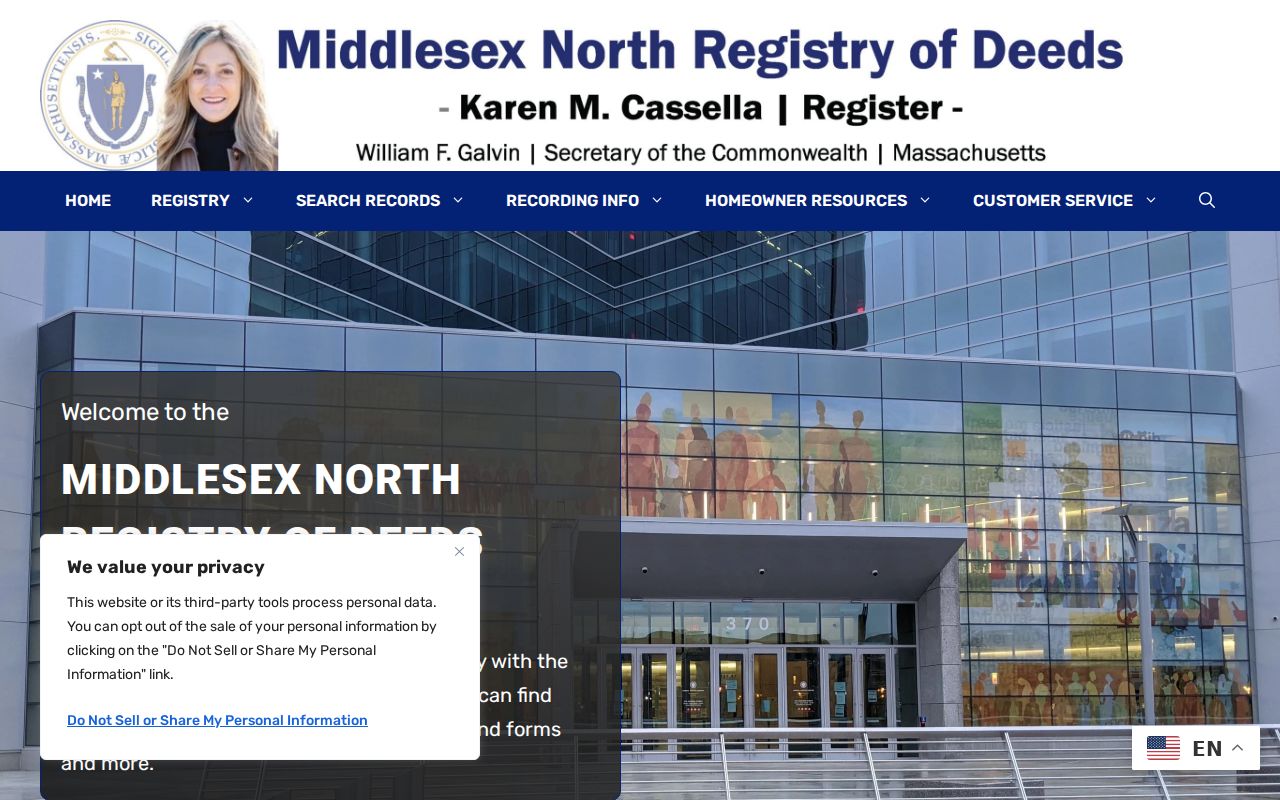
The Registry describes free searching, viewing, printing, and downloading of its records. Its online material reaches back through copied older records, but the search method changes with the era. A recorded party is a useful point in the chain, not proof that the person lived at the property.
- Preserve the current parcel ID, situs, owner field, sale clue, and the original address form.
- Find the current owner’s purchase, and copy the seller, recording date, book/page or instrument number, document type, and legal description.
- Search that seller as a grantee to find the earlier purchase, then repeat the same documentation for each prior transfer.
- When the result is missing, switch from the Recorded Land name index to Book Search, Unindexed Property Search, scanned grantor/grantee pages, or the Registry counter route.
- Grantor
- The party conveying an interest in a recorded document.
- Grantee
- The party receiving that interest. In a backward search, a seller’s earlier purchase often appears under that person as grantee.
- Chain of title
- The succession of recorded transfers for a property or interest, documented one record at a time.
- Legal description
- The parcel description in a deed or plan. It can use lot, boundary, road, or neighbor references that outlast a street-number change.
Westford Previous Resident Index Eras
The registry’s search tools have real cutoffs. Recorded Land name search covers 1976 to the present, with some imported 1976–1986 entries showing document type as “none.” Book Search reaches from 1950. The Unindexed Property Search covers Books 1–1131, from 1855 through December 1949. Pre-1855 material uses copied records and index books, and property names or legal descriptions may work better than a modern street string.
The Registry’s historic search instructions are useful when a name result seems absent.
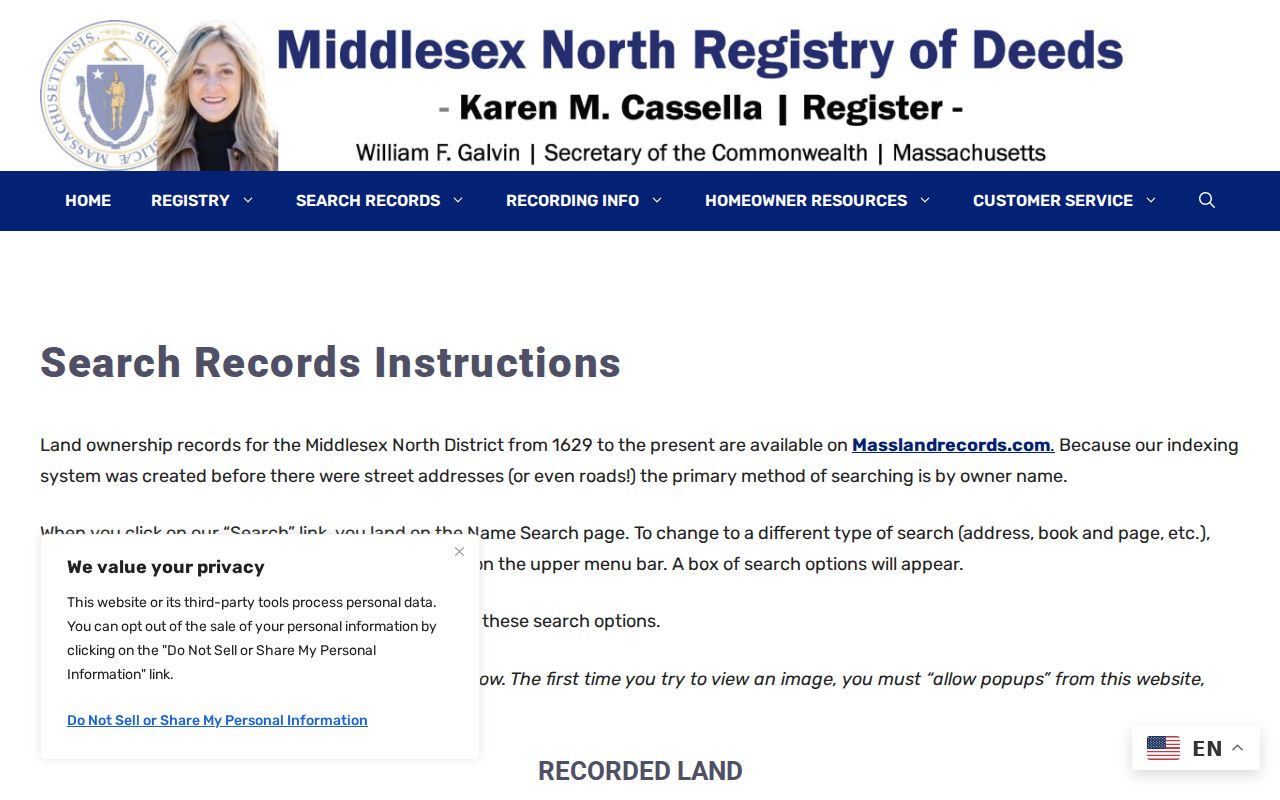
Inspect adjacent index pages and, when appropriate, the preceding image page. Books 1132–1590 can display each page separately, while later books generally use multi-page document images. Keep a note when only an index was inspected. It prevents an index entry from being treated as a fully read deed.
Note: Westford records predating standardized addresses often need a name, plan, boundary, or historic-map crosswalk before a current number becomes useful.
Westford Past Residents by Household
Property owners are only part of a house history. To find past residents who may not be deed parties, pair a directory edition with the nearest released census and then corroborate with a newspaper, tax list, cemetery source, or probate file. The State Library’s verified directory runs include 1896–1901, 1911–1916, 1919, 1927, 1930–1933, 1937–1941, 1953, 1955, 1961, and 1967. Fletcher Library and the Historical Society describe local street listings back to the 1980s, but no exact Westford reverse-directory run was confirmed.
- Record the directory year, title page, page or image, printed name, address, and any household notation.
- Compare it with the census year, enumeration district or page, household order, and the original image.
- Use the 1855 or 1865 Massachusetts census where it fits the address trail, then compare a deed or map for parcel continuity.
- Treat the mostly lost 1890 federal census as a record gap, not proof that a household was absent.
The collections themselves are described on the Westford city directories resource. For this address trail, the important task is matching each household snapshot to the deed and map evidence on either side of it.
Westford Previous Resident Map Clues
Historic maps can bridge the distance between an old description and a current parcel. The 1855 Symmes map, along with Hales 1831, Beers 1875, and Walker 1889 references in Historic Center material, can connect roads, property names, and occupancy leads. Compare map labels with Registry plans, GIS roads, deeds, and historic-house summaries. Retain the map year and its original labels.
The Masslandrecords Consumer Notification Service shows the Registry’s separate property-alert route.
It allows alerts for up to three properties when a document is recorded in a selected name or address. It is a property-fraud tool, not a way to locate people. The Registry also warns that unofficial deed-copy mailings can charge far more than the official free-copy route, so use the registry site directly.
Sanborn evidence is narrower than many researchers expect. The identified item is the 1907 Lowell volume, republished in 1952, which includes parts of Westford. It is not a comprehensive Westford map series. That limit is useful information when a house cannot be found on the available sheet.
Westford Previous Resident News Leads
Newspapers can help date a household or property event when a directory gap interrupts the trail. Fletcher Library identifies the Rustic for 1885 and Eagle or Westford Eagle holdings for 1970 through 1976 in the online viewer. Search a surname alone, a surname with a street, a quoted full name, a school or church, an event, and a narrow date window. Save the title, issue date, page, item URL, and whether the image supports the OCR reading.
Westford’s scanned newspaper collection provides the searchable route for the identified online issues. An announcement is a lead, not a substitute for a vital certificate, deed, or court file. Confirm the kind of event that the article reports with the custodian record that applies to it.
Westford Previous Resident Archives
The Historical Society provides another route for house history: historic-house summaries, photographs, deed indexes for 1629–1855, annual reports, maps, local directories, state-census material, and cemetery or school resources. Its research library is at Museum Cottage, 4 Boston Road, open Monday, Wednesday, and Friday from 9:00 to 1:00, with the posted phone number 978-692-5550. Verify availability before a visit.
The Westford Town Archives outlines additional finding aids.
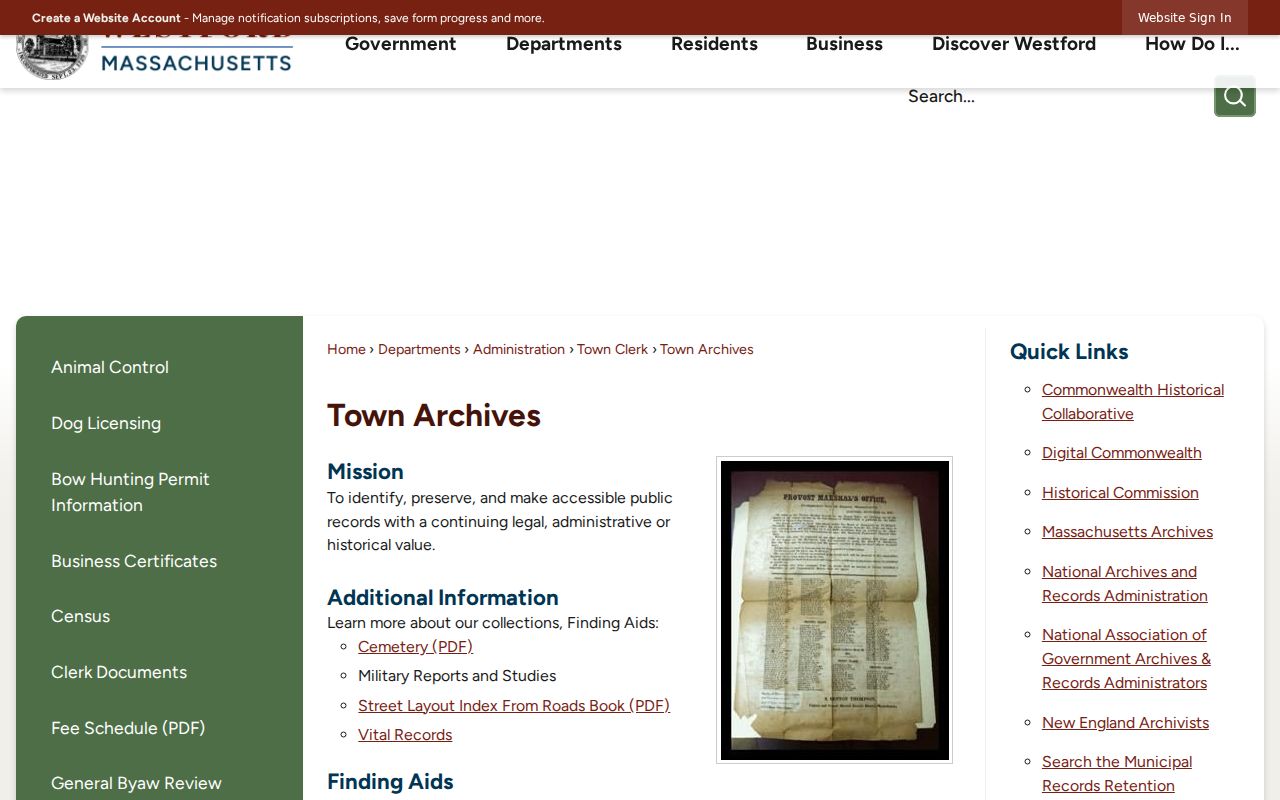
The archives point to cemetery records, the street-layout index from the roads book, vital records, and state or federal archive links. Fletcher Library’s local-history material is temporarily affected by its building move, so confirm whether a needed collection is offsite before relying on an older finding aid.
For a difficult house history, make a short worksheet before contacting a repository. Include the original address, later address forms, parcel ID, deed book/page, likely dates, village or road name, and the exact question that remains unanswered. That gives the library, archive, or Historical Society a clear way to match a map, tax list, directory, photograph, or roads-book entry without turning a partial clue into a claimed household history.
Westford Previous Resident Address Limits
Westford’s 2008 address report documents duplicate street names, street-type conflicts, missing numbers, unofficial driveways, and databases built around inconsistent addressing. It does not establish one universal renumbering year. Preserve the original address from every record and write down the record date, road variant, village label, legal description, and current parcel crosswalk separately. A modern address should never silently replace the form used in a nineteenth-century deed or directory.
Obituaries, cemetery records, and probate filings can help close a historical trail, but each is source-specific. The library’s newspaper collections and Historical Society files can supply leads. Confirm a death with a vital or cemetery record, a property claim with the Registry or assessor, and a family relationship through the official probate proceeding where available.